Thursday, June 1, 2017

Two Years In

All photos will be from the second year of service. This is in Dadal Soum, Khentii
Two years ago yesterday, Sally and I disembarked from a plane in Ulaanbaatar after a 36 hour day. We were extremely stressed out and excited after resigning our jobs and packing our possessions away. Everything was new and unknown. We were adventurers on a journey into a strange land and culture.  Now after two years, it is hard to believe that the time has gone by so fast and that we have spent a solid two years living in a country that is 8,000 miles from what we consider home.

In just a short two months, we will be leaving Mongolia and will have completed our PC service of 26 months. These are some of the things we will miss about Mongolia.
Both of these are also from Dadal, Checkout the Momgolia series from last May/June 
1.       Mongolians—There are many friends and coworkers who we have interacted with on a daily or weekly basis, and these people will be missed dearly, but there are also specific characteristics of Mongolians that we will miss.
·         Mongolian Bluntness/Honesty—I recently climbed into the car of a friend I had not seen in a while and he said after hearing me speak, “Your Mongolian is so bad. You have lived here two years, but your Mongolian is very bad.” It takes some time to get used to this level of directness, but in many ways it is nice. There is no beating around the bush, and people express both positive and negative thoughts.   This directness doesn’t extend to all social interactions, but in the area of personal criticism or compliments, it is nice.
·         Difficult to Offend—another aspect of Mongolians is that they can be quite forgiving of a foreigner, so it is usually difficult to offend people in day-to-day interactions. This is not to say that there are not social graces that should be observed, but in general, people are easy-going.
·         Laid back—when we go to UB, we often take a taxi into some of the worst traffic in central Asia.  I look around and marvel at how relaxed the drivers are even though every imaginable traffic offence is occurring around them or caused by them. Every time we travel through this, I find that I am usually far more stressed out by how slow and difficult the traffic is than the driver, even though I haven’t driven a car in two years.   
·         Mongolian hospitality—I often joke that no one is starving in Mongolia. This probably isn’t true, but it is nonetheless a society that is centered around food and drink hospitality. If I smell something nice in my apartment hallway, then it would be perfectly okay for me to wander into my neighbor’s apartment and sit down at their table to eat.  The understanding would be that I was lucky to have arrived when they were cooking food. I have never done this, because it is hard to set aside a lifetime of American ideals, but there have been many times when I have been fed or, at minimum, given tea to drink. In the countryside where there may be miles between gers, this hospitality is even greater.
Swimming in the Kherlen in Khentii during the Kherlen River Camp
2.       Mongolian Kids—The little ones are cute and generally sweet. It has really been a pleasure to work with them. Teenagers still have all of their angst, but there is a built-in respect for elders that makes it easier to be around them too.
Hiking near the Jamboree last Summer in Tov Aimag
3.       Wide Open Lands—I have written much about missing the woods of Alabama, but I will also miss the beautiful countryside of Mongolia. If you Google image Mongolia, you will get hundreds of pictures of amazing scenic open land. This representation of Mongolia on Google is entirely accurate. Everywhere in the Mongolian countryside we have traveled to has been beautiful.  Sometimes the landscapes have a stark, deadly beauty, at other times it is meandering streams and herds of live stalk.  We will miss it.


4.       Mongolian Wind—I personally will miss the wind. I don’t always like the wind and sandstorms, but it is nice to have a regular breeze across the steppe, especially during the summer. Alabama summer is the kind of heat that doesn’t move unless there is a front coming in.
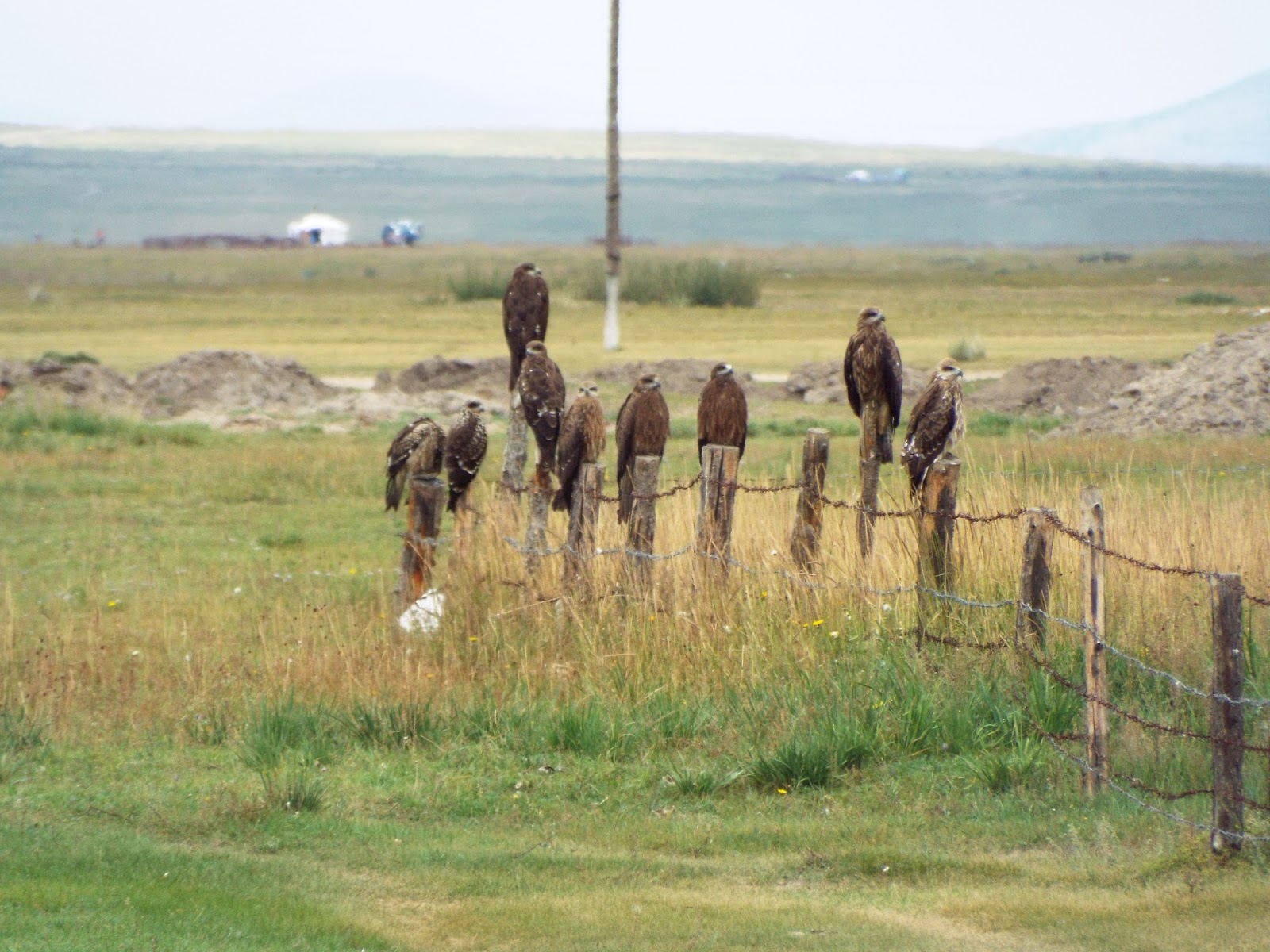
Hawks in Khentii
5.       Mongolian Winter—The winter was something I was most worried about prior to coming to Mongolia, and now having experience the freezing temperatures,  I really enjoyed the season.  I like bundling up in a ton of clothing, navigating -40 degrees, and never sweating. I recognize that part of the reason I like the winter is because I know this is all temporary. In the winter in Mongolia, the air can be so brisk and invigorating. I think the most difficult thing is how abysmally long winter is here. If I could get the power and punch of Mongolian winter in just a 2 month period that would be nice, but it is not realistic.
Mid-Service Training in Terelj, Tov
6.       Easy Transportation—This is a miss-labeled topic, because transportation in Mongolia is not easy, but during our time here, Sally and I have not had to worry about driving or dealing with the stress of navigating traffic.  It is hard to really convey how nice not driving can be. I do miss driving for the sake of enjoyment or long rides on deserted country roads. When we return to America and hit the speeding highways again, where just one mistake from a nearby car could remove us from the face of the earth, I think I will miss the slow stress free life of not driving here.  Another great aspect of life in Mongolia is that everything is within walking distance, so it is easy to live without a car.
Blue Lake in Khentii
7.       Affordable Fresh Food—It’s been really nice to have regular access to fresh produce. The selection is usually limited, but there is something satisfying about being the first person to wash dirt from a carrot.
·         Easy Shopping—This is in no way representative with most PCVs in Mongolia, but in our city, it is usually easy for me to visit about 6 or 7 stores and vegetable stands on my weekly shopping trips. The stores are within a mile of each other, and it is satisfying to know that I am buying items from a number of people and spreading my money around to look for the best commodity. There are small supermarkets here, but it is rare to find everything you need in just one, so it is nice to spread out your shopping. It is also great to know that most stores are family owned, so you are contributing to the local economy rather than a powerful industry like so many stores in America.


Eagle Fest in Uvs and Ulgii Province Last October
8.       Feeling safe—As a foreigner in Mongolia, we are often the blunt of negative attention, but this is usually not dangerous. I have seen a lot of confrontations between people both in Mongolia and America. In America, when you see people yelling in the parking lot of your apartment complex, the thought that always rest in the background is “Will someone pull a gun? Should I have a gun?” In America with the sheer number of guns this is not an unfounded question. In Mongolia there are not many guns and confrontations rarely lead to using one. Just knowing how unlikely it is that a gun will make an appearance in any setting is really comforting and makes someone without a gun feel more confident about handling challenging situations.  (This is not a political statement regarding American gun laws)
Winter in Khentii
9.       Time—We have a lot of it here in Mongolia. Things are generally laid back, and work weeks are not necessarily full time. It has been nice to have time to cook, read, exercise, and pursue a number of other hobbies we are interested in. Having time to do things you want to do and to relax is sometimes a privilege in our high speed American culture. The best way to summarize the passage of time here is that the days are long, but the months are short.
Close of Service Conference, Tov 
10.   PCV family—Sally and I have had the chance to build a lot of great friendships with a lot of great people. We are especially close to our Khentii PCV friends. Going to American means that we will all be scattered across the continent again, and while we do have friendships that will last a lifetime, we will miss how often we have been able to see them.  In PC, we don’t have friends, we got family! (Immortal F&F quote)


~Caleb 

Tuesday, May 23, 2017

Alcohol in Mongolia

This is a challenging post to write, because it is a complex issue. I think the best way to handle this is to discuss the media and data before moving into the realm of personal experience.
Media evidence in the form of reports and studies is conflicting. The World Health Organization released its last report on alcohol in Mongolia in 2013. It found that, on average, adults ages 15+ consumed 6.9 liters of alcohol each year. 70% of these liters were in the form of spirits (vodka).  27% of the adult population reported heavy episodic drinking and 6.4% reported alcohol related disorders. Based on this data alone, Mongolia’s alcohol problem is significantly less than a number of countries including the US, Japan, Canada, South Korea, and Russia with a whopping 15.1 liters consumption per person.

This doesn’t seem so bad until you start looking between the lines. According to an NPR report from 2009, Mongolia had one store selling alcohol for every 270 people, thus leading the world in alcohol availability.  I can vouch for this, since you can purchase hard alcohol in almost every food store in our city, even small neighborhood shops. Prices for 750 ml of Vodka can range between $3-10 making it very affordable.

A second disturbing statistic is the rate of liver cancer deaths (63.2/100,000 people each year). This is twice as high as Mozambique, the runner up. There are a number of factors that can affect this rate, and alcohol may not be the primary cause, but there is generally a correlation between liver cancer and alcohol use.

In March of this year, a personal idol of mine, the Dalai Lama told John Oliver that he has been promoting the drinking of airag (fermented mare’s milk) in Mongolia as an alternative to hard liquor, thus leading to a decline in the rates of alcohol use in Mongolia. While it is true that airag has a much lower alcohol concentration, it is not as easy to come by in its off season. It is likely that the decrease in alcohol use in Mongolia over the past few decades is related to the economy improving until about 2013. Since the boom of 2013, the Mongolian economy has been getting weaker.

The data, aside from liver cancer and availability, is actually not too bad in comparison with a number of other countries including the US, but it is still a significant public health problem in Mongolia.


That captures the data. Now let’s tackle the issue from personal experience, alcohol is something that Sally and I have encountered a lot in our service. Often, teachers’ celebrations or social events involve drinking large amounts of alcohol usually in the form of shots of vodka. Drinking is such an important part of social events that it often seems disrespectful to refuse.  Mongolians love to toast and share a bottle of vodka with friends.

Over the course of my service, I have begun to recognize the signs of alcohol dependency among some of the men that I know, and wisdom has taught me to avoid drinking with them, because it would never end.  Service in Mongolia also means that you develop a lot of ways to avoid getting drunk at an event where the social pressure is to binge. These methods can be anything from tossing the shot over your shoulder to pretending to drink.

PC service in Mongolia means that you become accustom to being approached by drunks on the streets who are emboldened by their condition. Usually it is just harmless curiosity, but it is something that many volunteers deal with on a day-to-day basis. When I started my service, I would stop and have conversations out of respect for the older men, but now I don’t engage often to the point of quickly skipping around them before they can reach me to shake my hand.

Alcohol and the effects of alcohol are everywhere, even in the States, but in a culture where alcohol plays such a key role in important parties and events, it does seem like this is more of a public health issues than the data would suggest. Part of the reason is that there is a general lack of understanding of healthy drinking habits in Mongolia. If a bottle of vodka makes an appearance at a social event, then the entire bottle will be drunk. Usually there is another bottle hidden out of sight. The dangers of binging that has been drilled into the heads of American youth are not as widely discussed here, and moderation in drinking is not the norm among those that do drink.

In addition to poor drinking practices, the economy of Mongolia is not fairing as well as it did in 2013. The continual decline of the tugrik and issues with unemployment lead to an increase in dependence on alcohol.

However, the country recognizes that it has a problem with alcohol and a number of public incentives have been put into place to reduce drinking habits. Drunks are also viewed unfavorably in Mongolia, but there is still a woeful lack of treatment centers for people with addiction. A large percentage of the Mongolian population does not drink, and an additional percentage only drink in social settings. The issue is that these settings are often binge situations.

So to close out a delicate post, I would finish by saying that Mongolia is improving on this issue, but it is still a big enough part of society that PCVs in Mongolia will encounter alcohol issues on a regular basis.

~Caleb  


Reference sites:

http://www.npr.org/sections/goatsandsoda/2017/03/09/519226175/looking-into-the-horse-milk-story-that-the-dalai-lama-told-john-oliver

Tuesday, May 9, 2017

Close of Service


The end is near. Really it is less than three months away.  Sally and I have spent 23 months in Mongolia. We have seen two entire cycles around the sun. We are familiar with the weather, the seasons, and the culture of this place that has been our home for so long.
Sally and I both got a haircut at COS

Last week Sally and I traveled to UB to attend our last Peace Corps seminar. It was the last time that our cohort will be in one place together. Many of our friends who we met in May two years ago we will not see in this country again. When we left for Mongolia so long ago there were 74 of us. Now for a wide variety of reason there are only 54. 

Coming to Mongolia felt like closing a book on a chapter of our lives. As our service comes to an end it is clear that yet another chapter is coming to a close. Our time in Mongolia has gone by slowly and quickly. It has been a time of trial and ease. A literal constant state of adjustment.

Our Close of Service (COS) seminar took place at a nice resort a short ways from UB. During the seminar we were briefed on a lot of the logistics of our upcoming departure as well as a number of sessions devoted to how to integrate successfully into American society with cryptic titles like “Resume Building, Elevator Pitches, etc.”  COS was also where we were informed of our departure date from Mongolia. Our cohort is leaving the country in three groups during the summer. Sally and I will be departing from Mongolia in July making our total time in country around 26 months. For Security reasons, I will not post the exact date, but close friends and family are welcome to message me. 
Pictures of the countryside around the resort. This stream still has ice.

Sally, Kyra, and Feebee

The mountains looked like Mordor

COS was a time of great food, a chance to renew relationships, make promises about the states, but most of all a celebration of our collective cohort’s success and growth.  At the end of the seminar, we received a certificate from our Country Director and took a picture before the joint flags of Mongolia, America, and Peace Corps.


Our last picture with our entire cohort of volunteers, "The COSing 54"

On Saturday, we departed from UB on a now familiar bus to our city. Spring has arrived in torrents of sand and wind; slowly the rolling hills of Khentii are turning green yet again.  We stopped at the half way point in the small village of Tsenkhermandal. With nearly two years of traveling the same stretch of road from the capital to our provincial center, we’ve had the chance to watch some of the shops flourish and die. A mini-mart that was a personal favorite in this halfway point didn’t last through the winter.
Pics with friends, our Khentii group won a prize at an evening event.
Even though this is the beginning of the end, there is still a lot to look forward to in the future. Sally
and I are in the process of planning a short summer trip to the Gobi desert, an area of Mongolia we have yet to see. We are also planning a longer trip when we leave the country. This trip will take us through a number of countries in central/eastern Europe.  From Europe we will fly back to our home in Birmingham, thus circumnavigation the globe in 26 months! Look for more information on both of these trips soon!

Workwise, we are in the process of finishing some of the classes and clubs we teach and are preparing for the summer which is usually much less busy than the school year for volunteers who work at schools.  I am currently working with my teachers to plan for an English Summer camp at my school.

But mostly at this point with just three months to go, we are excited to return to America. It has been a long separation from our homeland and family.


~Caleb